"Everything has changed about search, but at the same time, nothing has changed about search.”
People are still turning to search when they have questions to answer, problems to solve and decisions to make. What is changing is how they get those answers. Instead of simply pointing users toward information for interpretation, AI-assisted search platforms are interpreting the information and providing the answer.
Table of Contents
- What is the difference between search and AI-assisted search?
- Is AI Search Relevant for B2B?
- What Impacts AI Visibility?
- Known: Does AI understand who you are?
- Found: Do you appear in results for questions that matter?
- Trusted: Is there evidence to back up your claims?
Search is Becoming the Answer
What is the difference between search and AI-assisted search?
AI is changing the fundamentals of search. Before the onset of AI, "traditional" search began with a query and resulted in a list of websites the search engine felt answered the question. Traditional search relied on the user visiting the websites, performing their own research, interpreting the information and formulating an answer.
Search Results Website Research Conclusion
With AI-assisted search, research and interpretation happens before a user ever visits a website, if they visit the site at all. The LLM completes the research and interpretation by explaining, comparing and evaluating options from multiple sources. This means that the AI platforms influence which businesses, products and sources make it into the user's consideration set.
Question Synthesized answer Follow-up questions
Since the LLM is determining the answer, it becomes essential for any company to understand what AI knows about their business.
Is AI Search Relevant for B2B?
Yes, AI search is relevant for B2B. Professionals are turning to AI-assisted searches in the workplace. A recent study by Conductor found that 1 in 4 B2B searches generated an AI Overview. As people grow more comfortable using AI-assisted search in their personal lives, they will naturally trust the platforms to support their professional searches as well.
Looking at the broader search landscape, Comscore found AI Overviews appeared in 39.4% of all U.S. desktop Google searches in June 2026.
How has AI Search Impacted Click Behavior?
Ranking in the top 3 organic search results no longer guarantees success. Before AI-assisted search became the norm, the top 3 spots on a search engine results page naturally received the most clicks. However, this is no longer the case. Ahrefs analyzed 300,000 keywords and found that the presence of an AI Overview correlated with a 58% lower average CTR for the top-ranking page compared with searches without AI Overviews.
So, what should we focus on? AI visibility.
With the rise of AI-assisted search, businesses need to start focusing on AI visibility and being understood by LLMs.
What is AI visibility? AI visibility is how often, how accurately and how prominently a business appears in AI-generated answers.
Put simply: Is your business part of the answer, and is what AI says about you accurate?
AI Visibility is More than SEO Rankings
In this new AI-driven world of marketing, we need to move past our hyper-fixation on organic search rankings and start focusing on AI visibility. The good news is that what drives AI visibility is nothing new. Many SEO best -practices align with what we know to be the foundation of AEO and GEO (answer engine optimization and generative engine optimization).
Content still matters, but content alone isn't enough. AEO/GEO puts a stronger emphasis on quality, trust and context. Businesses need to think beyond what appears on their own website and consider the broader information ecosystem that helps AI systems understand who they are, what they know and why they should be trusted.
What Impacts AI Visibility?
AI visibility is heavily influenced by signals across first- and third-party sources. What a business says about itself is only part of the equation. What others say matters too, and arguably more than ever. Earned media, reviews and outside experts can validate what a company says about itself and build credibility beyond owned channels.
-
Website content and technical SEO
-
Thought leadership
-
PR and earned media
-
Case studies
-
Reviews
-
Social content
-
Industry organizations and publications
-
Visible subject-matter experts
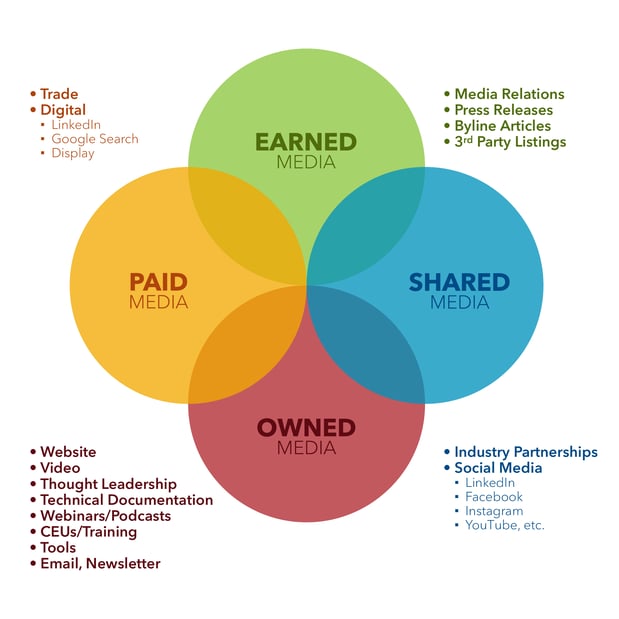
For B2B companies, platforms like LinkedIn play an important role for individual subject-matter experts. A company's expertise doesn't exist solely on its corporate website or LinkedIn profile. Engineers, executives, researchers and other specialists can demonstrate expertise through LinkedIn posts, industry publications, conference presentations and other channels where their knowledge is visible publicly. Their expertise sends a strong trust signal to LLMs, elevating not just them but the business as well.
Does SEO Still Matter?
AI visibility does not mean that SEO best practices are now obsolete. In fact, a strong SEO foundation is also a strong foundation for AI visibility. Technical SEO, clear site architecture, descriptive page titles and headings, internal linking, structured data and high-quality content all help establish your expertise. The difference is that success can no longer be measured by rankings and organic traffic alone.
SEO helps make your website discoverable. AI visibility expands the focus to whether your business is understood, included in relevant answers and supported by credible sources beyond your website.
A Practical Framework for AI Visibility: Known. Found. Trusted.
Known: Does AI understand who you are?
Ask yourself, are you confident that AI understands your business?
The question isn't simply whether your business appears online. It is whether the information is accurate and easy to comprehend. If it's difficult for your audience to understand what you do, don't assume an AI system will get it right either.
Questions businesses should ask:
-
Is it immediately clear what we do?
-
Are our products/services clearly defined?
-
Are the industries and audiences we serve apparent?
-
Are we using terminology customers use?
-
Is the way we're described consistent across the web?
-
Is our expertise associated with the topics we want to be known for?
Found: Do you appear in results for questions that matter?
Is your business included when customers ask certain questions? Are you part of the conversation? People are not necessarily turning to AI-assisted search to ask "who is company X?" Instead, they are asking:
-
"What's the best material for X?"
-
"How do I solve Y?"
-
"What companies provide Z?"
Meaningful AI visibility means appearing in the conversations that align with your customers' needs and your business's expertise. This means your business needs useful content around the problems, questions, comparisons and decisions surrounding your expertise. This shouldn't be sales materials, but rather educational content that allows LLMs to confidently mention and cite your business in their responses.
Evolution of an Education Center
A great example of educational content in action is the Glass Education Center by Vitro Architectural Glass. This website was originally built in 2019 to act as an educational hub for architects to learn about designing and specifying glass. It was created to capture the knowledge of Vitro's own experts and has since evolved to include articles, videos, infographics and presentations. While the original intent of the Glass Education Center was not to bring in website traffic, it has over time become a main driver of Vitro's online visibility both in search and AI. Recently, the Glass Education Center has undergone another evolution, optimizing the existing content for LLMs, further positioning Vitro as a leader in the glass architectural space.
Trusted: Is there evidence to back up your claims?
This may be the most important evolution in search. Can your business be trusted as an expert? Any company can make claims on their website but does the rest of the internet back up those claims? There needs to be evidence that your expertise is credible. That’s why PR, thought leadership, social media and customer proof matter to AI visibility. They help establish expertise beyond a company’s own website and give outside sources more opportunities to reinforce it.
Research from Muck Rack's What Is AI Reading? found that more than 84% of citations in the AI responses it analyzed came from earned and third-party sources. This means that your business needs to be present on more than just your website. The goal of AI visibility is to ensure your business is part of the answer, whether that is a brand mention or website citation. It is just as valuable to have an AI Overview cite an industry article highlighting your brand as it is to have one cite a link to your website.
These types of third party validation include:
-
Earned media
-
Industry publications
-
Associations
-
Reviews
-
Customer stories
-
Citations
-
Executive/SME thought leadership
-
Speaking engagements
-
Original research or data
Getting Quoted with Qwoted
Third-party validation and placements don't always mean high profile coverage in tier-one media outlets. In many cases, hyper-relevant and niche outlets offer the third-party validation needed for LLMs and are often cited in AI-responses. How do you secure these placements? Recently, the National Aviary used Qwoted to secure placements in broader and niche publications. Qwoted is an online platform that connects journalists with expert sources. Through Qwoted, the National Aviary and its experts connected with journalists, resulting in nearly 12 billion impressions and counting. What started as niche placements expanded to coverage from major media outlets including National Geographic, AOL, MSN and USA Today.
The Good News: You Probably Don't Need to Start Over
These aren't entirely new rules. Search has long rewarded useful content, authoritative links, demonstrated expertise and trusted brands. PR teams have worked to build credibility through earned media. Content teams have answered customer questions. Subject-matter experts have shared expertise. Customers have provided reviews and testimonials.
AI visibility isn't about replacing those strategies. It's about connecting them.
SEO, content, PR, social media and brand reputation can no longer be treated as completely separate visibility channels. Together, they help shape the information environment AI systems use to understand and represent a business.
Find the Gap and Start There.
AI search may feel overwhelming, but it doesn't have to be. Asking yourself simple questions and answering them honestly will help identify areas your business needs to focus on and practical next steps to take.
A good place to start is with these questions:
-
Is it clear what we do?
-
Are we answering real customer questions?
-
Is our expertise visible beyond our website?
-
Can outside sources support our credibility?
-
Start by identifying your biggest visibility gap. Are you known? Are you found? Are you trusted?
You don't need to solve all three at once. Find where your business is weakest and start there. The goal isn't to reinvent your marketing strategy. It's to take the work you're already doing and make it work harder for the next iteration of search.
FAQs
What is AI visibility?
AI visibility refers to how often, accurately and prominently a business appears in AI-generated answers across platforms like Google AI Overviews, ChatGPT, Gemini, Claude and Perplexity.
What is the difference between SEO, AEO and GEO?
SEO, AEO and GEO overlap heavily. Search engine optimization (SEO) focuses on improving visibility in traditional search results. Answer engine optimization (AEO) focuses on making information easy for search and answer engines to understand and serve. Generative engine optimization (GEO) focuses on how a business' expertise appears in AI-generated responses.
Does SEO still matter for AI search?
Yes. Traditional SEO fundamentals such as crawlability, site structure, relevant content, internal linking, authority and clearly communicating what a page is about continue to matter. AI visibility weighs brand mentions, citations, third-party credibility and how accurately AI systems understand a business more heavily.
How can businesses improve their visibility in AI search?
Start by making sure your website clearly explains what your business does and answers the questions your customers actually ask. Then strengthen the signals around that content through thought leadership, earned media, industry publications, reviews, case studies, subject-matter experts and other credible third-party sources.
How can I tell if my company is visible in AI results?
Simply use AI-assisted search platforms like Google AI Overviews, ChatGPT, Gemini, Claude and Perplexity to test representative customer questions. Then document whether your brand is mentioned, cited and accurately described.
What types of content help improve AI visibility?
Useful educational content, product and service information, original research, expert commentary, case studies, comparison content, technical resources and content that directly answers customer questions can all contribute.